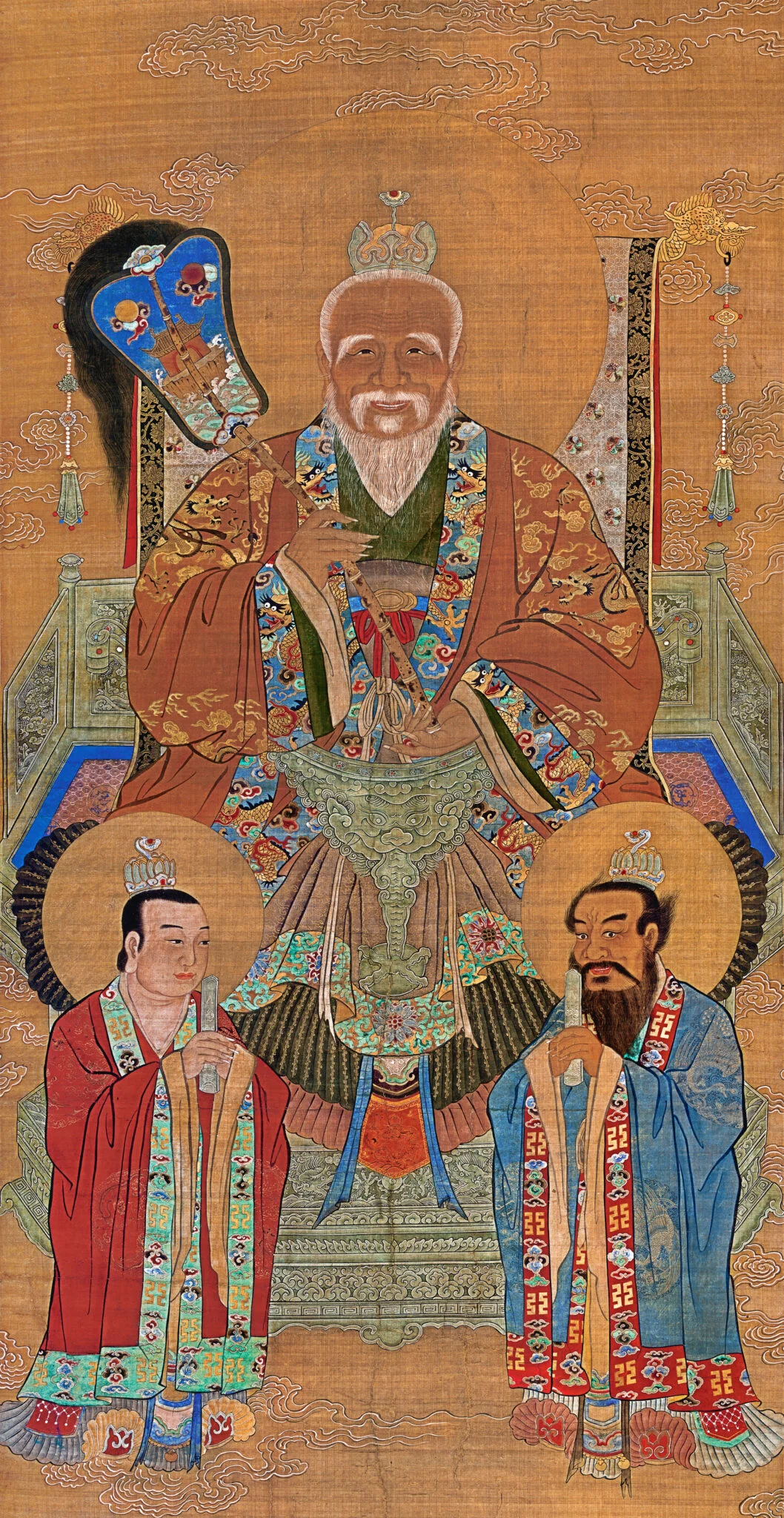
In addition to the Dao talks, as time allows we will practice scriptural work and meditation, this year’s monthly Daoist training will focus on the Daoist Immortals.
Dàodé Tiānzūn (道德天尊), also known as Tàishàng Lǎojūn (太上老君), is the third of the Three Pure Ones (三清) in Daoist cosmology and represents the Dao as it is lived, taught, and embodied in the world. While Yuánshǐ Tiānzūn symbolizes the primordial source and Língbǎo Tiānzūn expresses cosmic order and revelation, Dàodé Tiānzūn embodies the Dao as virtue (dé) in action—the ethical, relational, and practical expression of alignment with Dao.
Dàodé Tiānzūn is traditionally identified with Lǎozǐ,, the legendary author of the Dao De Jing. Through this association, he presides over the articulation of Dao through language, paradox, and teaching. His role is not to systematize doctrine but to transmit wisdom that dissolves rigidity, guiding beings toward simplicity, humility, and naturalness. The teachings attributed to him emphasize wu wei (effortless action), softness over force, and the power of yielding, offering a path of transformation accessible to everyday life.
Cosmologically, Dàodé Tiānzūn represents the Dao fully present within the manifest world. He bridges the transcendent and the ordinary, showing that enlightenment does not require withdrawal from society but can be realized through ordinary conduct infused with clarity and compassion. As the Celestial Worthy of the Way and its Virtue, he governs moral resonance rather than moral command—virtue that arises spontaneously when one lives in accordance with Dao, not through imposed rules.
In internal cultivation, Dàodé Tiānzūn corresponds to the integration of realization into character and behavior. If Yuanshi Tianzun is origin and Lingbao Tianzun is structure, Daode Tianzun is expression: how insight moves through speech, relationship, leadership, and service. He teaches that refinement is complete only when wisdom becomes embodied kindness, restraint, and humility.
Ultimately, Dàodé Tiānzūn represents the Dao walking among people. He reminds practitioners that the culmination of cultivation is not mystical attainment alone, but a life lived with integrity, simplicity, and quiet influence—allowing the Dao to act through one’s presence for the benefit of all beings.