Jan 1
/
Bernard Shannon
Restoring Virtue Meditation
Note: When practicing a visual dynamic meditation, it best to engage as many of the five-senses as possible.
Restoring Virtue Meditation is a dynamic, sensory-based practice for clearing emotional stagnation from the organs and replenishing their innate virtues.
Practitioners select one organ–element pair, adopt a supported posture and hand seal, and move through two phases: purgation, using breath and visualization to release the associated emotion, and restoration, inhaling color, fragrance, and virtue to refill the organ. With grounding, focused intention, and balanced timing, this meditation gradually dissolves internal burdens and restores emotional clarity, stability, and embodied virtue.
Practitioners select one organ–element pair, adopt a supported posture and hand seal, and move through two phases: purgation, using breath and visualization to release the associated emotion, and restoration, inhaling color, fragrance, and virtue to refill the organ. With grounding, focused intention, and balanced timing, this meditation gradually dissolves internal burdens and restores emotional clarity, stability, and embodied virtue.
While many practices suggest counting repetitions, I find that challenging because my awareness is split. Am I counting or am I engulfed in a practice? I encourage the use of a timer to surrender to the practice as fully as possible. (My preference is Insight Timer for many reasons. The most important is that I can set up countdown repeat timers with gongs or bells versus a buzzer).
As least initially, I would invite you to use a balanced approach: 10-15 minutes focused on purging and the same on tonifying. Either with guidance or experience, this ratio may change.
While it is possible to repeat this meditation for all five elements in one practice session, it is not recommended.
If while releasing emotions from one element and emotions associated with another arise, make note but stay focused. After the conclusion of the practice, a determination can be made if you are stable enough to release from another element or not. It might be best to wait, let things settle, and come back another day.
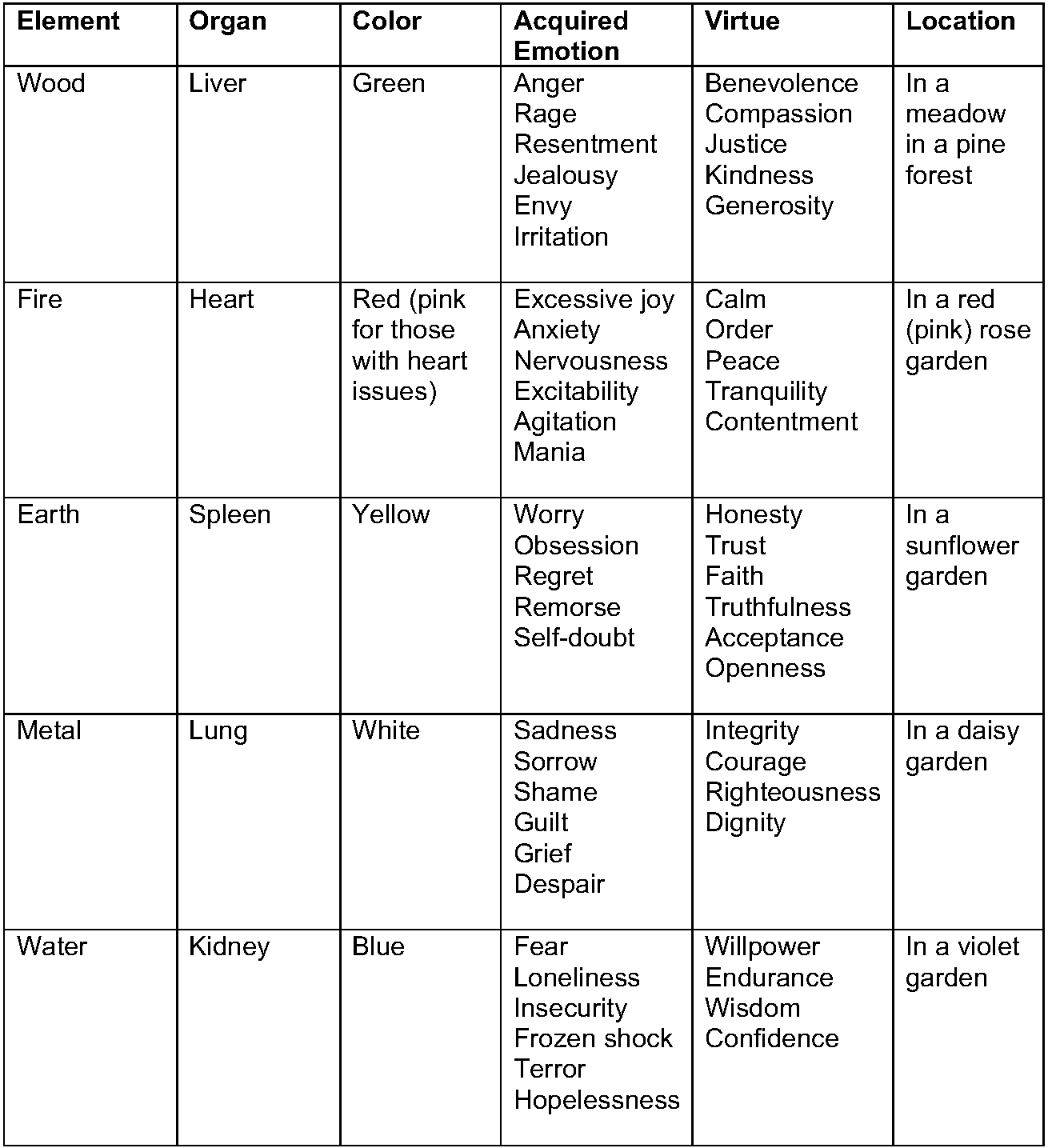
When you are ready to begin this practice, find a quiet, comfortable space where you can be undisturbed. To prepare for the practice, using the chart below, select one of the elements and its associated organ, color, acquired emotion, virtue, and location.
Posture
Use a posture (standing, sitting, lying) combined with a hand seal.
Sitting: Sit with your spine straight in a chair with your feet flat on the floor or cross-legged on a cushion. Rest your hands in your lap.
Standing: Stand with your feet about shoulder-width apart, parallel and hip-to-shoulder-width apart. Soften your knees, don't lock them, and sink your hips slightly. Ensure your spine is straight and your shoulders are relaxed down. Relax your neck and let the top of your head gently reach towards the sky. Allow your arms to rest by your side.
Lying: Lying flat on your back, legs hip-width apart with feet relaxed out, arms at your sides with palms up. Use pillows for head/knee support if needed for comfort and spinal alignment.
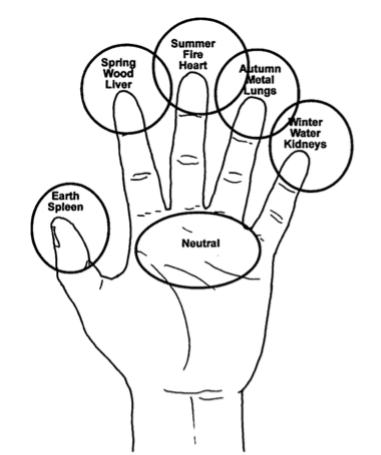
Hand Seal: On the left hand, touch the tip of the thumb to the tip of the associated finger. If you are using the Earth element, tough the thumb to the center of the palm. This Daoist Hand Seal is used to store and release the energy of the associated element.
Purgation Phase
Once you’ve settled into the posture, take three deep grounding breaths: inhale through your nose for 3-4 seconds, exhale through your mouth for 5-6 seconds.
Take a few moments to get in touch with one of the acquired emotions, only one, from the list that you choose to focus upon. Once selected, allow a memory of an event in which this emotion was present to be felt and feel it “whole and total” within your body. This represents 10/10.
Purging Breath
While focusing on releasing the acquired emotion from the selected organ, inhale through the nose for 3-4 seconds and exhale out the mouth for 5-6 seconds. If possible, focus the breath in the organ; feeling it rising and falling with the breath. For example, if working on the liver, when inhaling feel the liver physically move away from the center and return on exhale.
If emotions strongly arise and need to be stabilized, shift the focus of the breath to the lower Dantian, a point two inches below your navel, and use a balanced breath method, same length on inhale and exhale.
Purging Intention
This phase focuses solely on the exhalation.
See yourself in the selected location. Is it day or night? Can you see the sun or is it overcast? If during the day, can you feel the sun on your skin? If at night, how are you able to see? Moonlight, candles, lanterns? What is the temperature? What is the humidity? What can you smell? What do you see? What do you hear? If you are walking, upon what? What is the texture and sound from under your feet?
As you begin the practice, see yourself in the specific location, consumed with the selected emotion, using the purging breath releasing the pain breath by breath until completely deescalated.
As you exhale through the mouth, see a turbid/dirty vapor ot the variation of the selected color and feel the selected emotion being released from the body. See the color being drawn to and “inhaled” by the plants at your location. You can feel the plants absorb the emotion, digest it, and release it into the soil. Each exhaled breath lessens the charge that you feel.
At the conclusion of the purgation phase of the practice a 0/10 would be ideal, but rarely realistically occurs; just be honest with where you are at.
Restoration Phase
Take at least three deep grounding breaths to help center yourself: inhale through your nose for 3-4 seconds, exhale through your mouth for 5-6 seconds.
When ready shift to the tonification phase of this practice, take a few moments to get in touch with the one of the listed virtues, only one, from the list that you choose to focus upon for the organ you purged. Once selected, allow a memory of an event in which this virtue was present to be felt and feel it in your body. This represents the beginning perhaps a 1/10 or a 2/10. If you cannot “feel” it at all but understand its meaning then you are at 0/10. Wherever you are is fine, it is just a place to begin.
Tonifying Breath
While focusing on restoring the innate virtue of the selected organ, inhale through the nose for 5-6 seconds and exhale out the nose for 3-4 seconds. As above, if possible, focus the breath in the organ; feeling it rising and falling with the breath.
Tonifying Intention
This phase focuses solely on the inhalation.
As you begin the practice, inhale through the nose to the select organ, inhale the fragrance of the plants or flowers and see the selected color in a beautiful pure form be drawn in with the inhalation. Encoded within the fragrance and color is the selected virtue which awakens and nourishes the same within the organ.
Use the tonification breath to gather and restore the virtue breath by breath. As the organ and its virtue begin to fill and become radiant, the virtue overflows filling the body until the organ and body are completely full and radiant.
At the conclusion of the tonification phase of the practice, a 10/10 would be ideal, but it might not be there; just be honest with where you are at.
When the practice is complete stay still and quiet for several minutes before fully ending the session.